Georgian
c. 1700–c. 1780 · Colonial period
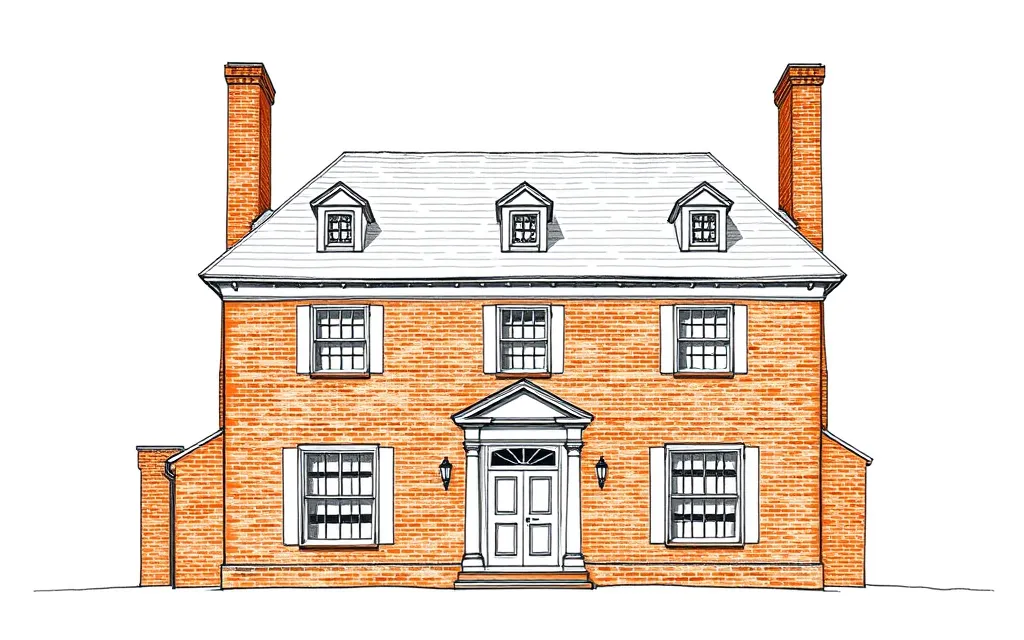
Formal, symmetrical houses with a centered paneled door under a decorative crown, evenly spaced sash windows in rows, and a cornice of classical moldings.
Description
Georgian houses brought the classical order of Renaissance England to the American colonies. They are boxy, two-story houses, usually five windows wide, with a center door, a strictly symmetrical front and a hipped or side-gabled roof.
Detail is concentrated around the front door, which has a paneled door with a rectangular transom of glass panes above, framed by pilasters and crowned with a pediment or flat entablature. A dentilled cornice runs along the eaves. Brick is typical in the South and Middle Colonies, and timber clapboards in New England.
Key characteristics
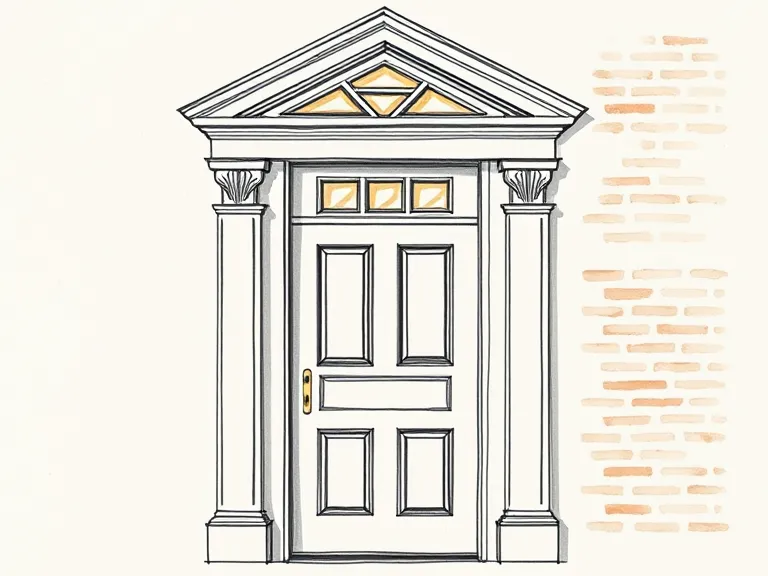
Crowned front door
A paneled door framed by pilasters, with a pediment or entablature above and a row of glass panes as a transom.
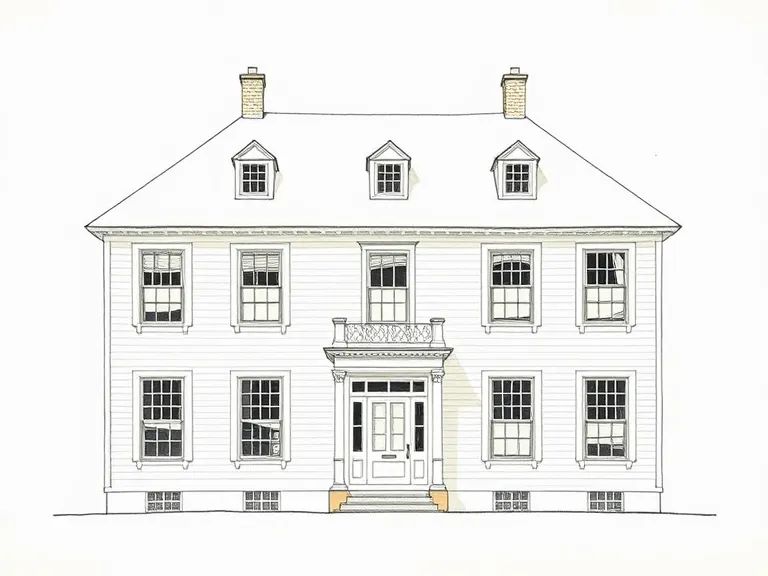
Symmetrical front
Usually five bays, with the door in the center and windows evenly spaced on both floors.
Multi-pane sash windows
Double-hung windows with small panes, often nine or twelve over nine or twelve, set in neat rows.
Dentilled cornice
A cornice of small toothlike blocks (dentils) along the eaves.
Paired chimneys
Chimneys at each end of the house or in pairs on a hipped roof.
Quoins and belt course
On grander houses, stone or wooden corner blocks and a horizontal band between floors.
Where you'll find it
- Annapolis MD
- Williamsburg VA
- Old Town Alexandria VA
- Portsmouth NH
- Newport RI
- Charleston SC
- Society Hill, Philadelphia PA
History and context
Georgian is named after the four King Georges who ruled Britain from 1714 to 1830. The style came to the colonies through English pattern books, carpenters' handbooks and immigrant builders, and became the standard for prosperous colonial houses from Virginia's tidewater plantations to the merchant towns of New England.
After independence, Georgian gave way to the lighter Federal style, but it never really disappeared. From the 1880s it was revived as part of the Colonial Revival, and Georgian Revival houses are still being built.
Georgian homes on history.house
No homes have been identified in this style yet. Identify your home's style from a photo, or search for an address.
Style names and periods follow Virginia Savage McAlester, A Field Guide to American Houses (1984; revised 2013). Sketches are illustrations generated for this guide, not photographs of real houses.