Public Housing Towers
c. 1940–c. 1975 · Postwar apartments period
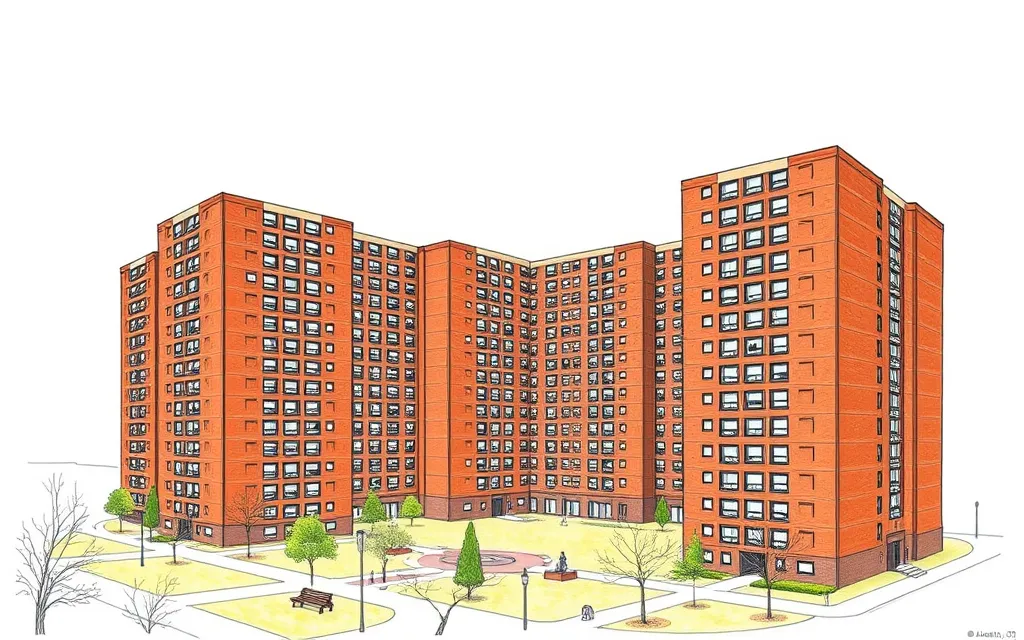
Groups of identical brick apartment towers and slabs set in open grounds, built by city housing authorities in the 'tower in the park' plan.
Description
Public housing towers were built by city housing authorities with federal funds, usually as large projects of identical buildings arranged across a superblock of open grounds, paths and play areas, away from the street grid. Most are of plain red or buff brick with a regular grid of windows.
Early projects of the 1930s and 1940s are low-rise, but from the late 1940s many cities built towers of six to fourteen stories or more, often in cross or slab shapes, served by elevators and open galleries or stair towers.
Key characteristics
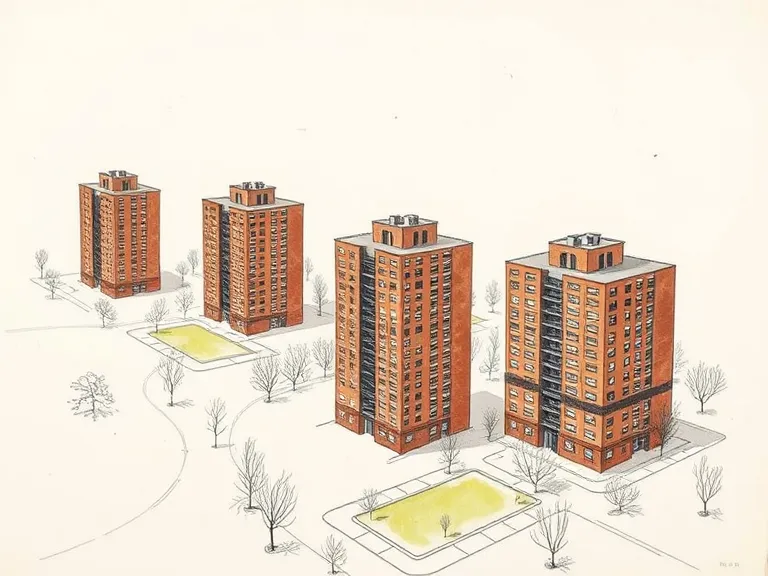
Tower in the park
Identical towers set apart in open lawns and paths on a superblock.
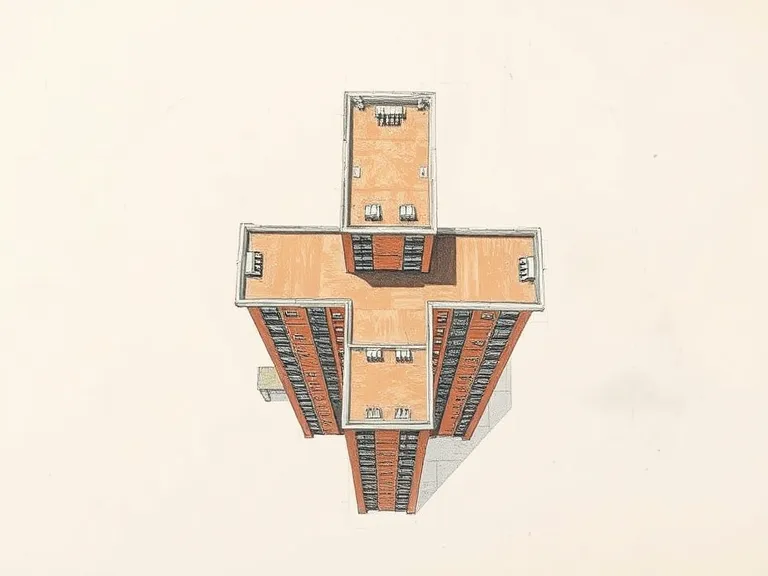
Cross-shaped plan
Towers with arms in a cross or X shape for light and air.
Plain brick
Red or buff brick walls with a regular grid of windows.
Superblock
Streets closed off to make one large site.
Open galleries
Exterior galleries or stair towers on some buildings.
Where you'll find it
- East Harlem, Manhattan NY
- Lower East Side, Manhattan NY
- Brownsville, Brooklyn NY
- Near North Side, Chicago IL
- South Boston MA
- Southwest Washington DC
History and context
The Housing Act of 1937 created federal funding for local public housing, and the Housing Act of 1949 expanded it alongside urban renewal. The New York City Housing Authority, the largest in the country, built hundreds of towers in the 'tower in the park' plan inspired by Le Corbusier.
Many projects suffered from poor maintenance and concentrated poverty, and some, such as Pruitt-Igoe in St. Louis and Chicago's Cabrini-Green, were demolished. New York's projects remain home to hundreds of thousands of people.
Public Housing Towers homes on history.house
No homes have been identified in this style yet. Identify your home's style from a photo, or search for an address.
Sources: Virginia Savage McAlester, A Field Guide to American Houses (1984; revised 2013); National Park Service, National Register of Historic Places nominations and multiple property documentation; Elizabeth Collins Cromley, Alone Together: A History of New York's Early Apartments (1990). Sketches are illustrations generated for this guide, not photographs of real buildings.