Contemporary Mid-rise Apartments
c. 2000– · Recent apartments period
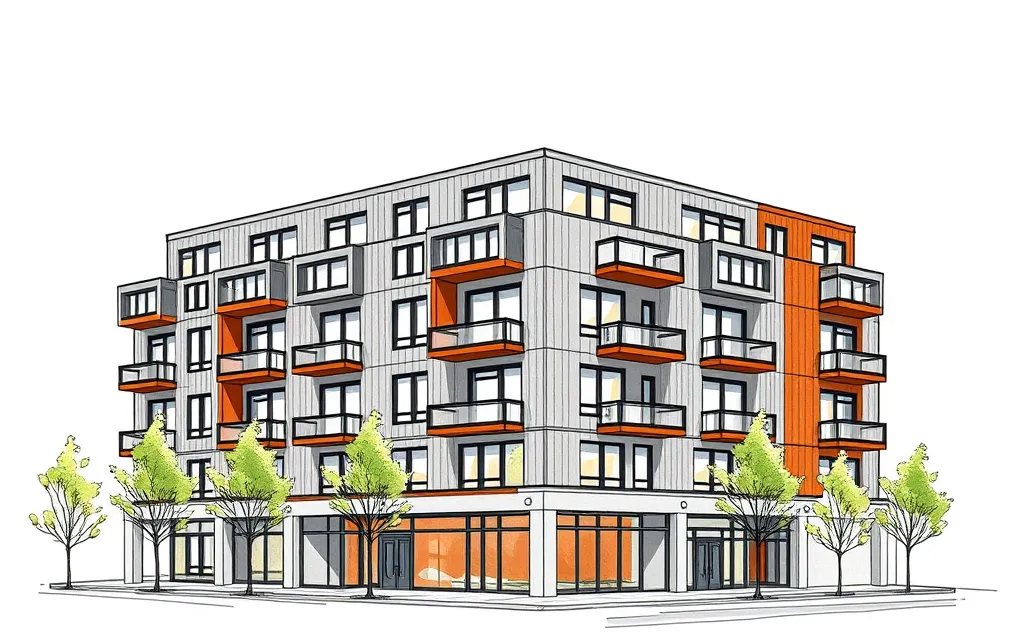
Five- to seven-story apartment buildings, often wood frame over a concrete podium of shops and parking, with mixed panel cladding and projecting bays.
Description
These are the apartment buildings that have filled main streets and transit corridors since the 2000s. Many are built as a 'five-over-one' or 'podium' building: four or five stories of wood framing on top of a concrete ground floor of shops, a lobby and parking.
Facades are broken up into blocks of different materials and colors, with fiber cement panels, metal, brick veneer and large windows, plus projecting bays and small balconies. The top floor is often marked by a cornice or a change of material.
Key characteristics
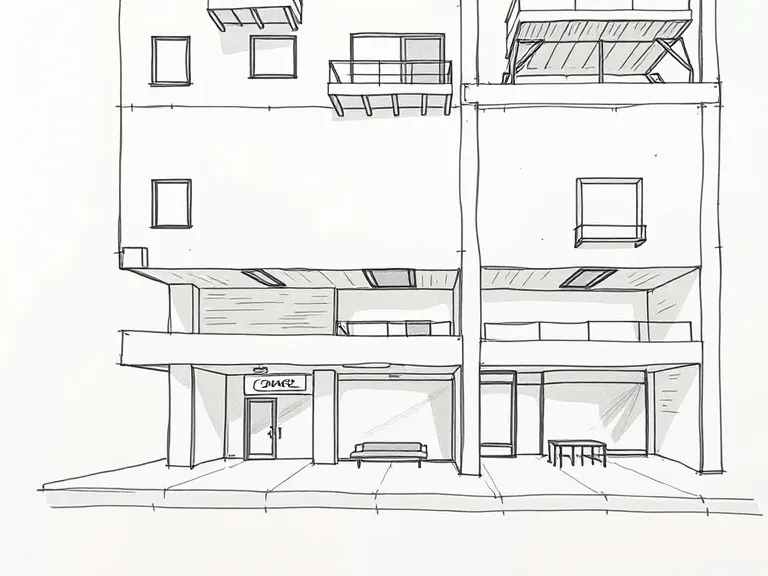
Concrete podium
A concrete ground floor of shops, a lobby and parking, with wood-framed floors above.
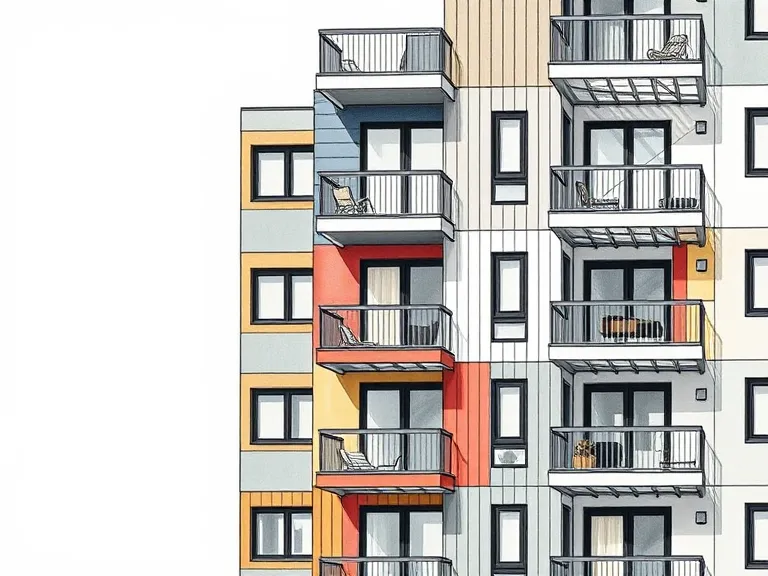
Mixed panels
Facades broken into panels of fiber cement, metal and brick in several colors.
Projecting bays
Boxy bays and small balconies stepping out from the facade.
Uniform height
Five to seven stories, set by building codes for wood construction.
Mixed use
Retail at street level, with apartments above.
Where you'll find it
- Capitol Hill, Seattle WA
- Ballard, Seattle WA
- Clarendon, Arlington VA
- Uptown, Minneapolis MN
- Pearl District, Portland OR
- East Austin TX
- RiNo, Denver CO
History and context
Building codes allow wood-framed buildings of about five stories over a concrete base, which is much cheaper than building all in concrete or steel. As cities encouraged housing near transit and on main streets from the 2000s, the five-over-one became the most common form of new apartment building in the United States.
Its look is the product of cost limits and design reviews asking for variety, and it is often criticized as generic. It has nevertheless added hundreds of thousands of homes to American cities.
Contemporary Mid-rise Apartments homes on history.house
No homes have been identified in this style yet. Identify your home's style from a photo, or search for an address.
Sources: Virginia Savage McAlester, A Field Guide to American Houses (1984; revised 2013); National Park Service, National Register of Historic Places nominations and multiple property documentation; Elizabeth Collins Cromley, Alone Together: A History of New York's Early Apartments (1990). Sketches are illustrations generated for this guide, not photographs of real buildings.