History of 2 Mandolong Rd, Mosman NSW 2088, Australia
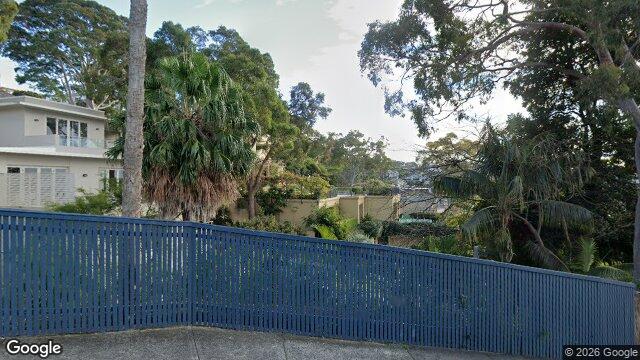
Google Street View
Architectural style
Overview
The house is only partly visible, but it appears to be a modest two-storey suburban dwelling with a light-coloured rendered exterior and a fairly simple, rectilinear form. From what can be seen, it reads as a mid-20th-century house that has either been altered or built in a restrained modern style rather than a highly decorative historic one.
Likely build era
My best estimate is c. 1940s–1960s, with the possibility of later alterations. The clean wall surfaces, lack of ornament, and boxy massing suggest a period when domestic architecture was moving away from the decorative timber and brick detailing of the Federation and inter-war years towards simpler, more functional forms. In Australian housing of this period, practicality, economy, and a lighter, more modern appearance were increasingly important.
Architectural style
Post-war International with possible Post-war Melbourne Regional influence.
This style grew out of modernist ideas that valued simplicity, functional planning, and reduced ornament. In everyday housing, that often meant flat or low-pitched roofs, smooth rendered walls, larger window openings, and an overall emphasis on clean lines rather than historical decoration. Even when adapted for suburban use, the result was usually a neat, understated house that looked more “architectural” than traditional, but still domestic and practical.
In an Australian setting, these houses often reflected post-war confidence and changing lifestyles: smaller households, new building materials, and a desire for a lighter, less fussy home. The style could also be adapted to sloping sites, which seems plausible here given the elevated position and retaining wall/fence in the foreground.
Style indicators
- Two-storey form: suggests a larger suburban house, often associated with post-war infill or a more substantial family home.
- Smooth rendered walls: consistent with modernist/post-war finishes rather than exposed decorative brickwork.
- Simple, box-like massing: points to functional planning and a reduced interest in ornament.
- Large horizontal window openings: visible on the upper level, which suit modernist ideas about light and outlook.
- Lack of decorative trim: no obvious verandah fretwork, ornate cornices, or historic mouldings visible.
- Elevated site and retaining wall: common in Australian suburbs built on slopes, where houses were designed to take advantage of views and breezes.
- Contemporary-looking fence and landscaping: these may not be original, but they reinforce the impression of a later-20th-century suburban setting.
Historical context
Homes like this emerged in a period when Australian housing was being reshaped by post-war population growth, changing household expectations, and new building technologies. Rendered masonry, improved plaster and concrete products, and standardised construction methods made it easier to build simpler houses with cleaner lines. Architects and builders were also responding to international modernism, but adapting it to local conditions such as strong sun, suburban lots, and sloping terrain. The result was a house type that signalled modernity, efficiency, and a more relaxed way of living — less about display, more about light, air, and practicality.
Confidence & caveats
The photo shows only part of the house, and much of the facade is obscured by the fence, trees, and angle of view. Because of that, the date and style are tentative: the building could be a later renovation of an older house, or a more recent home borrowing mid-century modern cues. A clearer view of the roofline, windows, and side elevations would help refine the reading.